“Smart in sensing” — Intelligent sensing solutions for tomorrow’s challenges.

How WIKA Pressure Gauges Work: A Complete Guide to Accurate Pressure Measurement
Learn how WIKA pressure gauges work, their key components, operating principles, applications, and why they are trusted across industries for precise and reliable pressure measurement.
5/8/20242 min read
Introduction
Pressure measurement is essential for maintaining the safety, efficiency, and reliability of industrial systems. Whether it's a manufacturing plant, hydraulic equipment, or a chemical processing facility, monitoring pressure helps ensure smooth operations and prevents equipment failure. Among the most trusted brands in pressure measurement, WIKA pressure gauges are known for their accuracy, durability, and consistent performance.
What Is a WIKA Pressure Gauge?
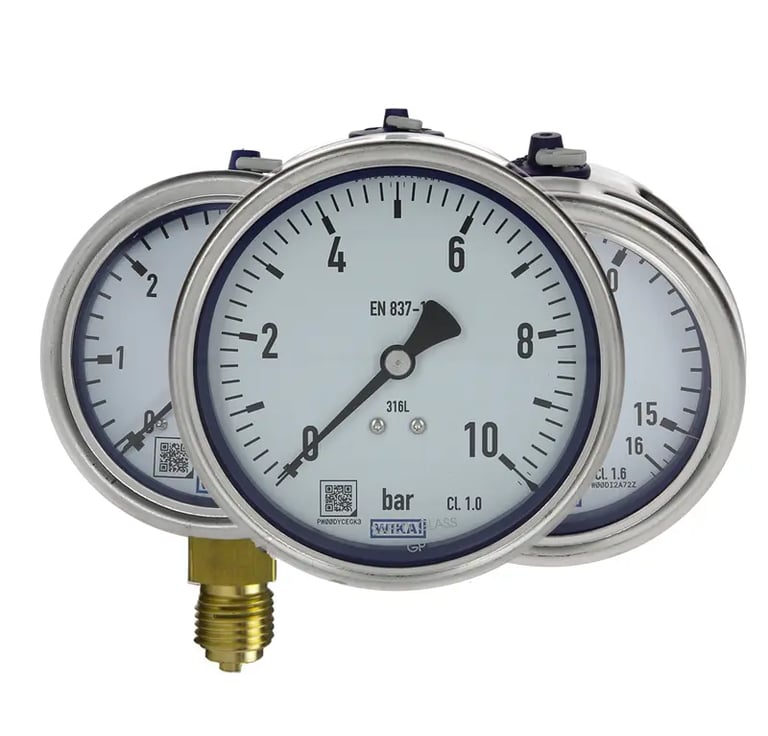
A WIKA pressure gauge is an instrument designed to measure the pressure of liquids or gases within a system. It provides real-time pressure readings, enabling operators to monitor process conditions and take corrective action when necessary. WIKA manufactures a wide range of pressure gauges suitable for standard, high-pressure, corrosive, and sanitary applications.
How Does a WIKA Pressure Gauge Work?
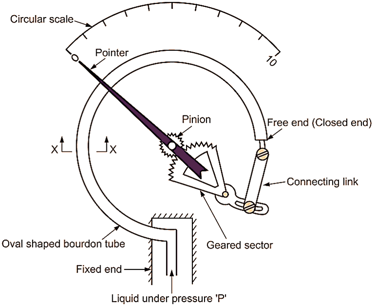
Most WIKA mechanical pressure gauges operate using a Bourdon tube, a curved metallic tube that reacts to pressure changes.
Here's how the process works:
1. Pressure Enters the Gauge
The process fluid or gas enters the gauge through the pressure connection and fills the Bourdon tube.
2. Bourdon Tube Expands
As the internal pressure increases, the curved Bourdon tube attempts to straighten. The amount of movement is directly proportional to the applied pressure.
3. Mechanical Linkage Transfers Motion
The movement of the Bourdon tube is transferred through a precision linkage and gear mechanism.
4. Pointer Displays the Reading
The gears rotate the pointer across a calibrated dial, displaying the pressure in units such as bar, psi, or MPa. When the pressure decreases, the Bourdon tube returns to its original shape, and the pointer moves back accordingly.
This simple yet highly reliable mechanism allows WIKA pressure gauges to deliver accurate readings without requiring an external power source.
Why Choose WIKA Pressure Gauges?
WIKA pressure gauges are trusted by industries worldwide because they offer:
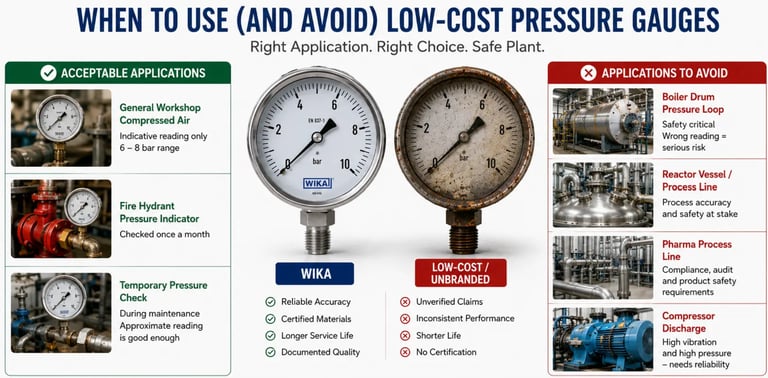
High measurement accuracy
Durable stainless-steel construction
Excellent resistance to vibration and corrosion
Long service life
Low maintenance requirements
Reliable performance in demanding industrial environments
These qualities make them suitable for both routine monitoring and critical industrial processes.
Common Applications
WIKA pressure gauges are widely used across industries, including:
Oil and gas
Chemical processing
Water and wastewater treatment
Food and beverage manufacturing
Pharmaceuticals
HVAC systems
Hydraulic and pneumatic equipment
Power generation
Their versatility allows them to perform reliably in both standard and challenging operating conditions.
Maintenance Tips
To ensure accurate performance and extend the life of your WIKA pressure gauge:
Inspect the gauge regularly for signs of damage.
Avoid exceeding the maximum pressure rating.
Calibrate the gauge periodically.
Protect it from excessive vibration whenever possible.
Replace worn seals or fittings as needed.
Regular maintenance helps maintain measurement accuracy and reduces unexpected downtime.
Conclusion
WIKA pressure gauges combine precision engineering with robust construction to provide dependable pressure measurement across a wide range of industrial applications. Their proven Bourdon tube mechanism ensures accurate and reliable readings, making them an excellent choice for businesses that prioritize operational efficiency and safety. Whether you're monitoring hydraulic systems, industrial machinery, or process equipment, a WIKA pressure gauge offers the performance and reliability needed for consistent results.
Contact
Reach out for expert measurement support
Phone
wikainstrumentsservices@gmail.com
+91-9211342233
© 2026. All rights reserved.